First or Second Flight: Decoding the Cappadocia Sunrise Hot Air Balloon Timings
If you have been researching Cappadocia hot air balloon rides, you may have come across the terms "first flight" and "second flight" — and wondered what the difference is and which one to choose. It is one of the most frequently asked questions among travelers planning their balloon experience, and the answer is more nuanced than a simple "one is better than the other." This detailed guide explains the mechanics of each flight window, compares the experience from multiple angles — light quality, availability, pricing, photography, and atmosphere — and helps you make the decision that is right for your specific priorities. Use BalloonScanner.com to compare operators offering both flight windows and book with confidence.
How the Two Flight Windows Work
Commercial hot air balloon operations in Cappadocia are structured around the stable atmospheric conditions that exist in the two to three hours immediately around sunrise. As the earth warms through the morning, thermal convection increases and surface wind becomes less predictable — making balloon navigation more challenging and landing more variable. To maximize safety and flight quality, Cappadocia operators have settled into a two-flight-window structure:
The First Flight Window
First-flight balloons begin inflation approximately 60–75 minutes before sunrise. The actual launch — the moment the balloon lifts from the ground — occurs roughly 20–30 minutes before the sun crests the horizon. The balloon is therefore aloft before, during, and immediately after sunrise. For a 60-minute flight, passengers experience the entire arc of the dawn — from pre-dawn twilight through the moment of sunrise to the early golden hour.
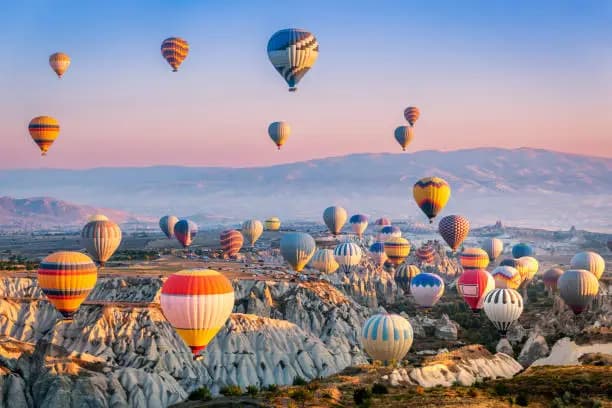
First flights are the traditional, classic Cappadocia balloon experience. The vast majority of iconic Cappadocia balloon photographs — the ones with dozens of colorful balloons against a deep indigo-and-amber sky — are taken during the first-flight window. First-flight demand consistently exceeds second-flight demand, particularly in peak season.
The Second Flight Window
Second-flight balloons begin inflation after the first-flight balloons have landed. Depending on the season and actual first-flight timing, this means second flights typically launch 45–75 minutes after first flights — usually between 7:00 and 8:30 AM, depending on the season. By this time, the sun has already risen and is climbing the sky. Passengers experience full daylight and the warm, soft light of the early morning rather than the specific colors of the sunrise transition itself.
Second flights typically have fewer balloons in the air simultaneously (since some operators only run a single morning flight), offering a slightly less crowded airspace. The ground below is also more illuminated — details of the landscape, the colors of the rock formations, and the intricate textures of the fairy chimneys are more clearly visible than in the twilight of the first-flight launch.
Light Quality: The Most Important Difference for Photographers
For photographers — and photography is a primary motivation for many balloon passengers — light quality is the defining variable between the two flight windows.
First Flight: The Magic of Transition Light
The first-flight light is the most dramatic and most photographically rewarding. The sequence of lighting conditions during a 60–75 minute flight that begins pre-dawn is extraordinary:
- Pre-dawn (first 15–20 minutes aloft): Deep blue sky, long shadows, silhouetted fairy chimneys against a glowing eastern horizon. This is the light that makes the most iconic Cappadocia images.
- Sunrise moment (around 20–30 minutes into the flight): The sun breaks the horizon. The sky transitions from indigo to amber to gold. The first rays catch the tops of the rock formations and the balloon envelopes — a visual moment of extraordinary intensity.
- Post-sunrise golden hour (final 20–30 minutes): The light is warm, directional, and beautiful. Long shadows define the landscape's topography. This is when detailed landscape photography — capturing the carved cave dwellings, the vineyard terraces, the valley floors — is most rewarding.
Second Flight: Consistent, Clear, Beautiful Light
The second flight's light is consistently warm and soft — the established golden hour of early morning. There are no dramatic color transitions, but the quality of light is genuinely beautiful for landscape photography. The clarity is actually superior to the first flight in terms of detail: the low-angle but established sunlight illuminates the landscape more evenly than the extreme contrast of pre-sunrise light.
For photographers who prioritize even exposure and visible landscape detail over dramatic color drama, the second flight's light can actually be preferable. For those whose priority is capturing the iconic multi-balloon dawn image, the first flight is essential.
Availability and Booking Competition
First-flight slots are substantially more sought-after than second-flight slots. In peak season (April–June and September–October), first-flight slots with top-rated operators can sell out 8–12 weeks in advance. Second-flight slots typically remain available longer into the pre-trip booking window.
This has practical implications for your booking strategy:
- If the first flight is your priority, book as early as possible — 6–10 weeks in advance in peak season.
- If you are booking late (within 2–3 weeks of your trip in peak season), second-flight slots may be more readily available — and are a genuinely excellent experience rather than a consolation prize.
- BalloonScanner.com displays real-time availability for both flight windows across all certified operators, allowing you to instantly see which slots have availability for your dates.
Pricing Differences
In many cases, first and second flights are priced identically by operators — the flight experience itself (duration, basket size, inclusions) is the same, and operators do not always differentiate on price. However, there are some pricing dynamics worth knowing:
- Some operators offer second flights at a small discount (typically 5–10%) to incentivize take-up and fill remaining capacity.
- In less competitive booking windows (off-season, mid-week), operators may offer second-flight pricing as a way to move unsold inventory closer to departure date.
- Last-minute deals (available 24–48 hours before flight) are more commonly found in the second-flight window than the first.
BalloonScanner.com displays pricing for both flight windows side by side, so you can immediately see whether any discount applies to second flights with your preferred operators.
The Atmosphere: Different Energy, Same Magic
Beyond light and logistics, the atmosphere of the two flight windows is subtly but meaningfully different.
First Flight Atmosphere
The first flight has a particular electricity to it. The launch site is buzzing with dozens of crews and hundreds of passengers all animated by the same pre-dawn anticipation. Multiple balloons inflate simultaneously — a spectacular sight in itself. The sky is full of balloons at launch time, creating the iconic multi-balloon landscape that has made Cappadocia world-famous. The energy is excited, collective, and slightly awe-struck.
Second Flight Atmosphere
The second flight is calmer and more relaxed. The pre-dawn frenzy has passed. Fewer balloons are in the air simultaneously, which means the airspace feels more spacious. The temperature at ground level is warmer, making the pre-flight preparations more comfortable. The post-flight breakfast is served in full daylight, making it a more leisurely, pleasant affair. For travelers who prefer a quieter, more contemplative experience, the second flight's atmosphere can actually be more appealing.
Which Flight Should You Choose? A Decision Framework
There is no universally "correct" answer — both flights are genuinely wonderful. Use this framework to match the decision to your priorities:
Choose the First Flight If:
- Photography is a primary goal and you specifically want the drama of sunrise transition light
- You want the iconic multi-balloon image with dozens of balloons rising together
- You want the complete arc of the dawn experience from pre-sunrise to golden hour
- The early wake-up is manageable for you and your travel companions
- You are booking well in advance and can secure your preferred operator's first slot
Choose the Second Flight If:
- The very early wake-up time (4:00–4:30 AM) is a genuine hardship for you or members of your party
- You are traveling with young children for whom the ultra-early morning is problematic
- First-flight slots are no longer available with your preferred operator
- You prefer a quieter, less crowded atmosphere in the air
- Even morning light and landscape clarity are more important to you than sunrise color drama
- A small discount is available that makes the second flight significantly better value
A Practical Note on Launch Times by Season
Sunrise time in Cappadocia varies significantly by season, which affects the absolute clock times of both flight windows:
- Summer (June–August): Sunrise around 5:00–5:30 AM. First flight pickup around 4:00–4:30 AM; second flight around 6:30–7:00 AM.
- Spring and Autumn (March–May, September–November): Sunrise around 6:00–7:00 AM. First flight pickup around 5:00–5:30 AM; second flight around 7:30–8:00 AM.
- Winter (December–February): Sunrise around 7:00–7:30 AM. First flight pickup around 6:00–6:30 AM; second flight around 8:30–9:00 AM.
Winter second flights, in particular, have a notably more civilized launch time — making the choice between first and second flight less stark in cold months than in midsummer.
What Experienced Travelers Say
Among travelers who have taken both flight windows (either on different Cappadocia visits or as part of comparative experiences), the overwhelming consensus is that the first flight is the more memorable experience — primarily because of the specific quality of sunrise light and the atmosphere of dozens of balloons rising together at dawn. However, many of the same travelers also note that the second flight is "more relaxing" and "more comfortable" — and that the landscape is no less beautiful in established morning light than at the moment of dawn.
The unanimous view is that either flight, with a reputable operator, is a transformative experience. The first vs. second question is ultimately a refinement — both choices lead to an extraordinary morning. The more consequential choice, by far, is the operator you select. Use BalloonScanner.com to ensure that choice is a great one.
How BalloonScanner.com Helps You Choose
When searching on BalloonScanner.com, you can filter by flight window — seeing all first-flight and second-flight options separately, with real-time availability and pricing for each. The platform's package comparison tool allows you to evaluate whether a first-flight slot with your preferred operator is available, whether a discount applies to second-flight slots, and whether the quality difference between operators in each window is significant enough to affect your decision.
For most travelers, BalloonScanner.com's first recommendation is: book the best operator you can afford in the first-flight window as early as possible. If that is not available, book the same operator for the second flight rather than accepting a lower-quality operator for the first flight. Operator quality matters more than flight-window timing.
Conclusion: Both Flights, One Unforgettable Landscape
The first and second Cappadocia balloon flights offer different experiences of the same extraordinary landscape — each with its own specific beauty, atmosphere, and advantages. The first flight captures the magic of sunrise transition light and the drama of dozens of balloons rising together against a dawn sky. The second flight offers warmer morning light, a calmer atmosphere, and a more relaxed experience. Both are genuinely wonderful.
Make your choice based on your priorities — photography goals, wake-up time tolerance, availability with your preferred operator, and budget — and then focus your energy on choosing the best possible operator for that window. BalloonScanner.com makes both decisions easy with real-time availability, verified reviews, and transparent pricing across all certified Cappadocia balloon operators. Book smart, fly beautifully, and let Cappadocia work its magic — whatever time the sun rises that morning.


